
West Jordan Voter Lookup Fields
Utah's personal voter-status tool is the first stop for a West Jordan resident checking his or her own record. It is not a surname index and does not let a visitor browse everyone on a street. The form uses personal facts to match one registered voter. A successful match can return registration status, precinct and polling information, plus ballot or election details tied to that voter.
| Lookup input | Control | Needed | How it is used |
|---|---|---|---|
| First Name | Text | Yes | Identity input |
| Last Name | Text | Yes | Identity input |
| Date of Birth | Masked date | Yes | Protected authentication input |
| Street Address | Text | Yes | Registered residence |
| City | Text | Yes | Enter the registered city |
| ZIP | Masked ZIP | Yes | Registered postal code |
| reCAPTCHA | Challenge | Yes | Limits automated access |
A West Jordan voter should use the address held in the registration record, even if a recent move has changed the place where the voter now receives mail. West Jordan residents can also use Utah's separate address-only route for polling-place and precinct information. When a personal match fails, Salt Lake County Elections is the local administrator that can help resolve a registration issue. It is better to contact that office than to treat the self-check as a third-party people directory.
The official Utah self-lookup screen shows the personal fields used to verify a West Jordan record.
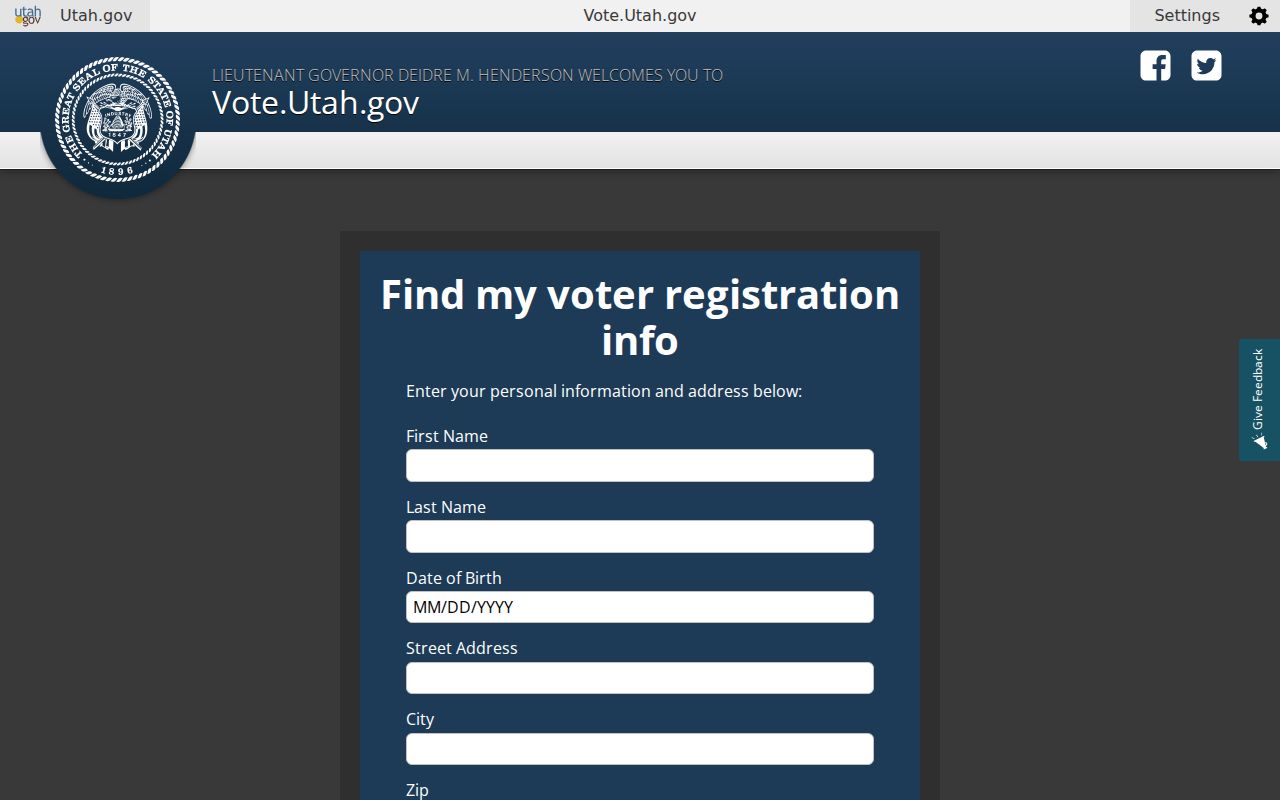
The screen's combination of birth date and registered address shows why it serves the voter, not someone trying to scan the voter rolls by name.
Note: The lookup is free, but all identity inputs and the anti-automation challenge are required in practice.
West Jordan Voter Record Inventory
A purchased Utah voter file covers West Jordan and is much broader than the personal status result. Utah Code §20A-2-602 defines the fields made available and the details held back. West Jordan registrations appear inside the statewide database and may also be obtained as a local subset through Salt Lake County Elections. The public part can connect a name to political districts and participation history, but it never reveals how anyone marked a ballot.
| Identity | Full legal name, voter ID, and age range |
|---|---|
| Addresses | Full residence and unit, county, mailing address, and mailing city |
| Election geography | Precinct plus congressional, state legislative, school board, county council, and city council districts |
| Affiliation | Political party or unaffiliated status |
| Record status | Active or inactive status and last update |
| Participation | Elections in which the voter participated, never selections made on a ballot |
District fields matter in West Jordan because a mailing city alone does not settle every boundary. County, legislative, school, council, and precinct lines can overlap in different ways. The voter record identifies the assignments used by election administrators. For genealogy or civic research, participation means only that a ballot was cast or the voter took part in a named election. Ballot secrecy remains intact.
Utah Voter Fields Kept Private
Public status does not make the whole registration form open. The same Utah statute that authorizes voter-data products limits what may leave election custody. This split is more precise than the general public, private, controlled, and protected classes used under the Government Records Access and Management Act. The broader Utah records framework is addressed with other custodian rules under West Jordan public records access.
Confidential under Utah Code §20A-2-602. Full birth dates, Social Security numbers, driver-license or state-ID numbers, signatures, phone numbers, and email addresses are withheld from the public voter file. Identifying information for approved At-Risk voters receives added protection.
For a West Jordan voter, an age range may appear where the full date of birth does not. A residence or mailing address may be present for an ordinary registration, while an At-Risk record is handled under stricter rules. Requesters should not infer that missing contact data was overlooked. Those omissions are built into Utah's disclosure law and apply to West Jordan voter records obtained from either the statewide or local route.
West Jordan At-Risk Voter Protection
Utah's At-Risk designation protects more than a single address field. Identifying information is withheld even from parties and candidates that would otherwise qualify to receive protected voter information. Limited aggregate facts may remain, such as city or county, age range, party, and participation. That lets election totals retain civic value without exposing a protected person's identifying details.
Eligibility includes victims or threatened victims of domestic or dating violence, law-enforcement personnel, armed-forces members, public figures, people covered by protective orders, and co-residents. A West Jordan applicant files with the county clerk and supplies proof. The Salt Lake County Elections office administers county voter records and is the correct local contact for the designation process.
For eligible West Jordan residents, the state Address Confidentiality Program is a related protection administered by Utah's Commission on Criminal and Juvenile Justice, while the voter-file rule governs what election data is released. These protections should not be collapsed into a simple opt-out. Each has official eligibility and documentation steps.
West Jordan Voter File Purchase
The Utah voter and election data service sells the statewide database for $1,050. The purchase is one-time, with no refund, subscription, or later update included. The file is tab-delimited, about 150 MB, and its download link is sent by email within one business day. The Lieutenant Governor provides statewide data only, so a buyer seeking just West Jordan or Salt Lake County should use the county route instead.
- Select the statewide voter database that includes West Jordan on the official data page and review the current statutory terms governing its use.
- Complete the state request and payment process. The $1,050 charge covers one delivery and does not include later changes.
- Use the emailed link to download the tab-delimited file, then retain its delivery date because the voter rolls continue to change.
The official election-data request page identifies the products, prices, delivery method, and access limits.
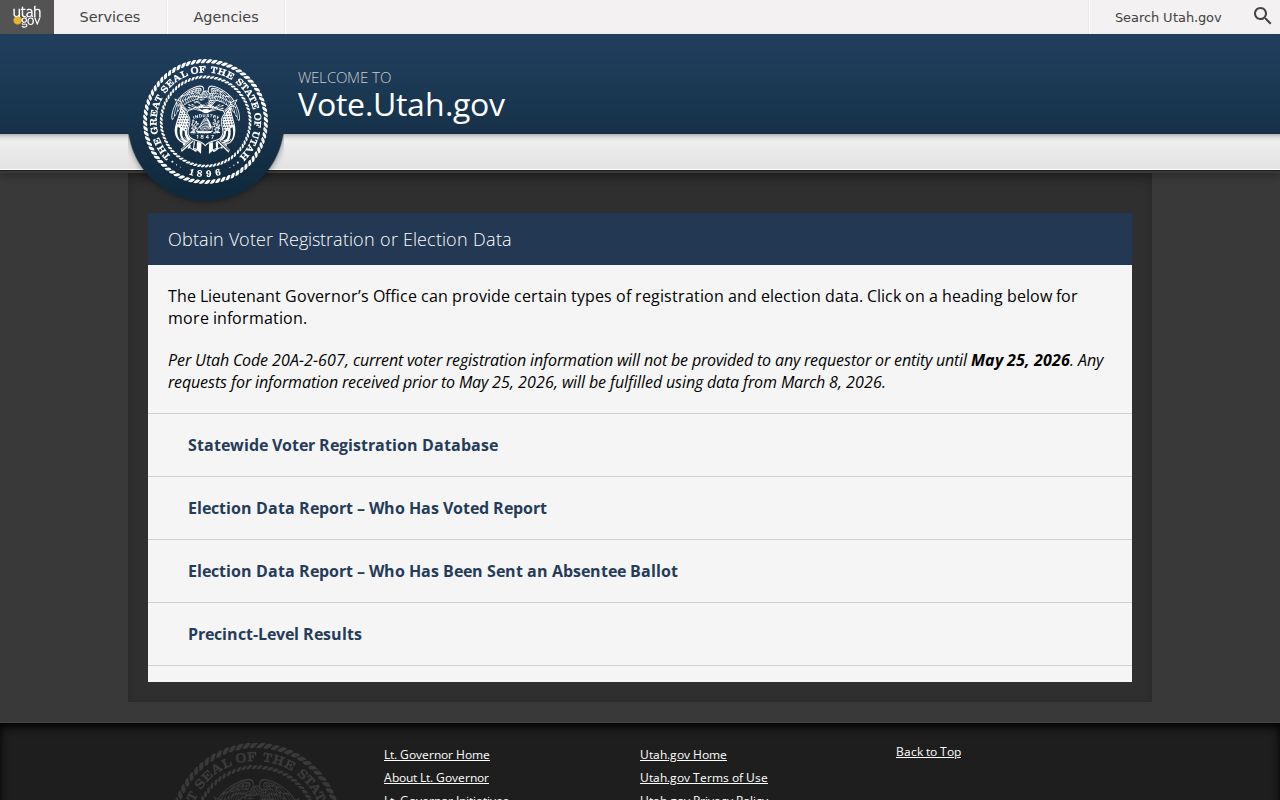
For West Jordan research, the request screen separates the statewide database from election-specific reports, a key distinction when the goal is a current registration file rather than a daily participation report.
Before purchase, identify the necessary scope. A one-time statewide file is costly and large. A West Jordan-focused need may be served by a Salt Lake County subset, while election-night research may need free precinct results instead. The research did not establish the current county-subset fee, so it should be confirmed directly rather than inferred from the state price.
Salt Lake County Voter Lists
Salt Lake County Elections handles local voter-data subsets and registration administration for West Jordan. The office is at 2001 South State Street, Suite S1-200, and is open weekdays from 8 a.m. to 5 p.m. Staff can be reached at 385-468-7400 or vote@saltlakecounty.gov. This county channel is the practical West Jordan fallback when the state self-lookup does not resolve a personal record or when a requester needs less than the full statewide database.
Salt Lake County Elections
2001 S State S1-200
Salt Lake City, Utah
385-468-7400
vote@saltlakecounty.gov
Weekdays, 8 a.m.-5 p.m.
Statewide and county files are distinct access channels. The Lieutenant Governor will not carve out West Jordan from the statewide product. The county office controls local subsets, but its current dynamic request fields and subset fee were not captured in the research. Ask the office for the current form, available geography, format, delivery timing, and charge before sending payment.
Note: A city name is not the only filter because West Jordan voters also fall within precinct and district boundaries.
West Jordan Vote History Limits
Utah offers West Jordan researchers more than one participation product. A “Who Has Voted” report records participation in a covered election. A “Who Has Been Sent an Absentee Ballot” report tracks ballot issuance. Each costs $35 per election and covers even-year regular primary and general elections. Delivery runs daily from 21 days before Election Day through the day before the election.
Neither product records a voter's choices. Participation history may show that a West Jordan voter took part, and an absentee report may show that election officials sent a ballot, but the secret ballot prevents either record from disclosing candidates or measures selected. Precinct results are free and show aggregate outcomes. They do not convert those totals into person-by-person choices.
Use voter data lawfully. Public access never authorizes stalking, threats, harassment, impersonation, or attempts to obtain protected voter information. Utah law can impose penalties based on the conduct, intent, repetition, and threat involved.
Maintaining West Jordan Voter Rolls
West Jordan registration files are not fixed directories. They carry active or inactive status and a last-update field because election offices process changes over time. Utah's monthly National Voter Registration Act reports cover confirmation cards, registration updates, and removals. Those reports are retained for two years, giving researchers a limited view of how the statewide list is maintained without revealing protected personal fields.
The official current and historical registration statistics provide statewide and county totals rather than a public name browser. On July 20, 2026, Utah reported 1,778,184 active registrations, 310,424 inactive registrations, and 2,088,612 total. These are dated statewide figures, not a West Jordan count. A current personal status should still be checked in the self-lookup, and fresh aggregate research should use the live statistics page.
An inactive label is an administrative status, not proof that a person moved or stopped voting. The last update and participation fields need context. For any question about a specific West Jordan registration, the voter or Salt Lake County Elections should resolve the record rather than relying on an old downloaded file.
Historic West Jordan Election Records
Older West Jordan election research sits within Salt Lake County and Utah record systems. County government records extend back to the territorial era in 1852, before today's city label and many modern precinct lines. A search based only on “West Jordan” can miss people indexed under an older county, precinct, school, water, church, or community boundary.
The Utah State Archives research catalog is the fallback for historical election and government series that are not part of the current self-lookup. Salt Lake County Archives also preserves historic county groups. Search catalog descriptions by office and record series, not merely by a resident's name. Poll books, registers, minutes, and district records may require browsing because older materials are not always full-text indexed.
Current West Jordan voter records and historic sources answer different questions. The live system can confirm today's status and election geography. Archival material can place a person in an earlier precinct or civic setting, but boundary changes must be reconciled before assuming the old label maps neatly to modern West Jordan.
West Jordan Voter Data in 2026
Utah Code §20A-2-607 created a temporary release pause that affected West Jordan in 2026. Until May 25, requests for current voter registration information were filled from a March 8, 2026 snapshot rather than a live file. That episode is complete. It should be described in the past tense, not presented as a current delay or a reason that new requests remain frozen.
The same period brought updated privacy material tied to SB 153, including the At-Risk category and wider anonymization or withholding rules. Current requests should use the live state forms and statute instead of old summaries. The statewide price is now $1,050, and a purchase still represents one dated delivery rather than a subscription.
This dated episode shows why the delivery date belongs in any analysis of West Jordan voter rolls. A March snapshot, a July statistics report, and a later county subset can each be accurate for its own date while carrying different totals or statuses. Record provenance means knowing which office supplied the file, its geographic scope, and when it was produced.